
How to Make Bougainvillea Bloom: The Ultimate Fertilizer & Care Guide
- May 22
- 3 min read

Is your bougainvillea a massive, tangled bush of beautiful green leaves—but completely devoid of those vibrant, jaw-dropping pink and purple flowers? It’s one of the most frustrating dilemmas in gardening. You water it, you nurture it, and in return, it just grows taller and greener.
Here’s the hard truth: You are likely killing your bougainvillea with kindness.
To get explosive color, you have to treat this plant a little rough. In this guide, you’ll learn:
The exact fertilizer ratios
The "secret" watering trick
The precise care steps required to turn your stubborn green bush into a backyard showstopper.
Why Your Bougainvillea Isn’t Blooming: The Nitrogen Trap
Before we talk about what to feed your plant, let’s discuss what you are probably overfeeding it: Nitrogen.
When you look at a fertilizer bag, you’ll see three numbers (like 10-10-10). This is the N-P-K ratio, which stands for:
Nitrogen (N): Promotes lush, green leaf growth.
Phosphorus (P): Stimulates root development and, crucially, blooming.
Potassium (K): Boosts overall plant health and disease resistance.
If you use a standard, high-nitrogen lawn or all-purpose plant food, the plant funnels all its energy into growing giant green leaves. It feels completely safe and happy, so it has absolutely no reason to reproduce (which is what blooming actually is). To force blooms, we have to change the menu.
The Best Fertilizer for Bougainvillea Blooms
To bloom bougainvillea with fertilizer and trigger a massive flush of color, you need a fertilizer that is low in nitrogen but exceptionally high in phosphorus and potassium.
The Ideal NPK Ratio
Look for specialized fertilizers with an NPK ratio like 5-10-10 or 10-20-20.
Don’t Forget the Micronutrients
Bougainvilleas are heavy feeders that require iron and magnesium to keep their colorful bracts (the "flowers") vibrant. Look for a fertilizer blend that includes:
Magnesium (often listed as Epsom salts or Mg)
Iron (to prevent yellowing leaves, a condition called chlorosis)
Sulfur (helps keep the soil slightly acidic, which bougainvilleas love)
Pro Tip: Look for fertilizers specifically labeled for Hibiscus, Bougainvillea, or "Bloom Boosters." Granular, slow-release formulas work best for in-ground plants, while water-soluble options are great for quick boosts in potted containers.
Step-by-Step: How to Force Your Bougainvillea to Bloom
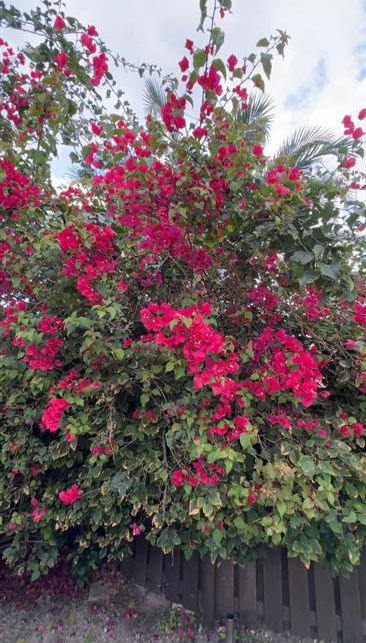
Applying the right fertilizer is only half the battle. To guarantee a spectacular bloom cycle, follow this step-by-step care routine:
Step 1: Time Your Fertilizer Application
For In-Ground Plants: Apply a granular 5-10-10 fertilizer once every 4 to 6 weeks throughout the spring and summer. Stop fertilizing entirely by mid-autumn to let the plant go dormant for winter.
For Potted Bougainvilleas: Nutrients wash out of containers quickly. Use a water-soluble bloom booster at half-strength every 2 to 3 weeks during the active growing season.
Step 2: Withhold Water (The Strategic Stress Trick)
Bougainvilleas are native to arid climates. In the wild, they bloom after a period of intense drought as a survival mechanism. If you keep the soil constantly moist, they won’t bother flowering.
Let the soil dry out completely. In fact, do not water your bougainvillea until the leaves just begin to wilt slightly.
Once you see that minor wilt, give it a deep, thorough soaking. This calculated environmental stress, combined with your high-phosphorus fertilizer, tricks the plant into an emergency blooming frenzy.
Step 3: Prune for "New Wood"
Bougainvilleas only produce blooms on new growth. If your plant has long, woody, established branches, it won’t flower there.
Whenever a blooming cycle ends, grab your pruning shears and trim the branches back by 3 to 6 inches.
This forces the plant to send out fresh, new shoots—and every single one of those new tips will soon be covered in brilliant color.
Step 4: Maximize Unobstructed Sunlight
No amount of fertilizer can save a bougainvillea stuck in the shade. These plants are sun worshippers. They require at least 6 hours of direct, unfiltered sunlight per day to produce intense color.
If your plant is under a tree canopy or shaded by a patio, consider relocating it to the hottest, sunniest spot in your yard.
Quick Troubleshooting FAQ
Why are my bougainvillea leaves turning yellow?
This is usually a sign of overwatering or an iron/magnesium deficiency. Scale back your watering immediately and apply a fertilizer containing chelated iron and micronutrients.
Can I use coffee grounds on my bougainvillea?
Coffee grounds add acidity to the soil, which bougainvilleas like, but they are also very high in nitrogen. Use them sparingly, or you risk triggering more green leaf growth instead of flowers.
How long does it take for a bougainvillea to bloom after fertilizing?
If you combine a low-nitrogen fertilizer with the strategic drought-stress method and plenty of sunlight, you can generally expect to see colorful bracts forming within a few weeks.


Comments